

See What You're Missing
You can do it
“How did you see that?”
People ask me that a lot.
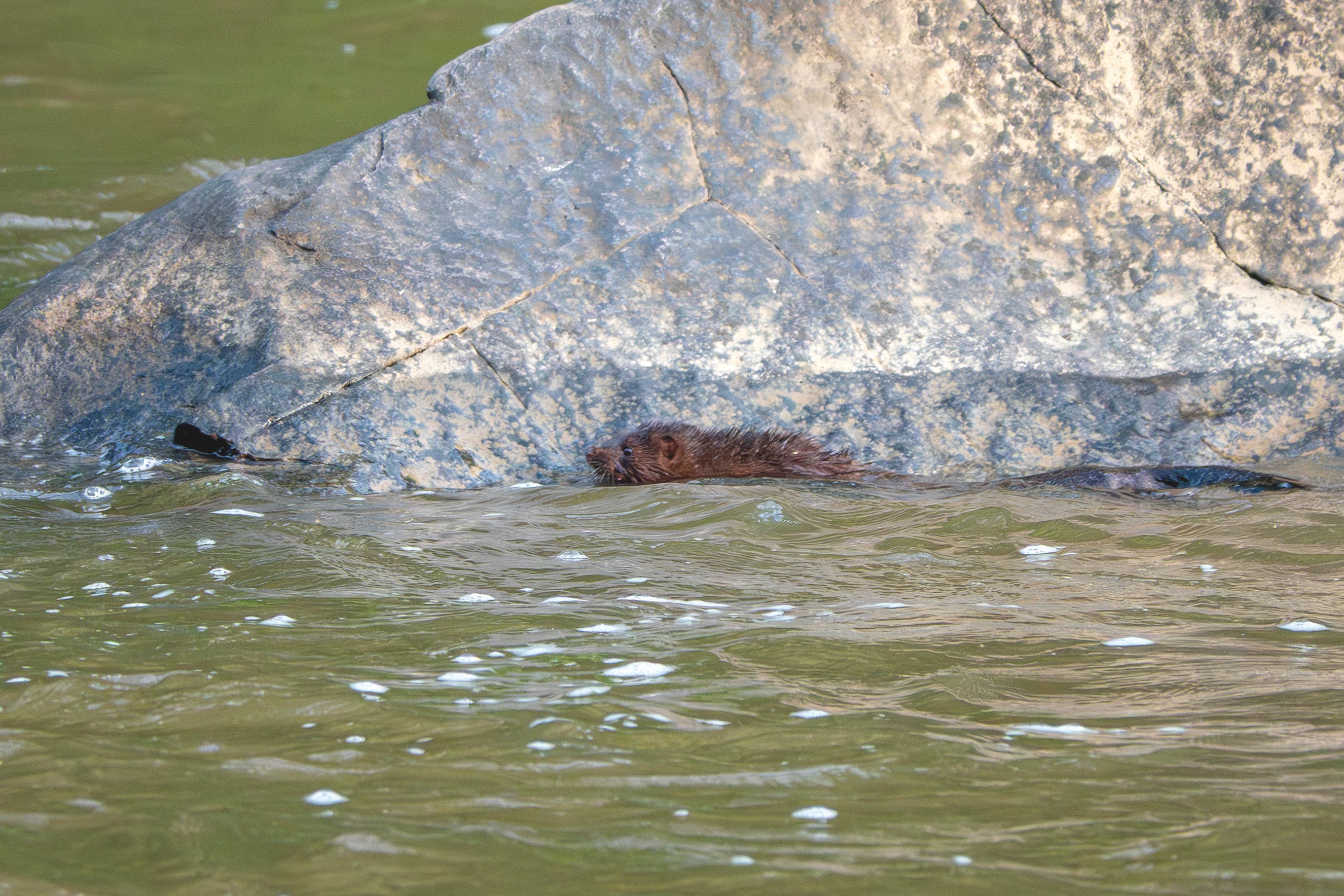
It comes up when I show people images of things in their neighborhood, like the minks in Lansdowne. The ones I discovered along Goose Creek, where my neighbors had walked for years without ever knowing they were there.
My eyesight is nothing special. I’m wearing glasses as I type this. By comparison, think for a moment about animals with superior vision. What comes to mind? Eagles, falcons? Their distance vision is tremendous, sort of unimaginable to most of us1. What about the best night vision? Cats of course. And so many other night-dwellers. I don’t have their abilities. I am not a falcon, and I’m not a house cat.2
By comparison, we humans might seem pretty feeble. Visually challenged, even. You may feel as if you can’t see anything, especially if you wear glasses. It’s downright embarrassing.
But what if you’re wrong?
Humans have a breadth of abilities that, taken together, are more powerful than we realize. It’s true, we can’t compete with “specialists” in their areas of strength. We can’t overcome distance like those raptors, and we don’t see too well in the dark. But our daylight detail vision is better than many animals’. It’s more precise. We also have excellent depth perception because our eyes face forward and overlap3. At the same time, we still keep a decent range of peripheral vision. Our peripheral can’t match prey animals like deer or rabbits, whose eyes sit farther around the sides of their heads, designed to detect danger. However, ours is still quite good.
But wait, there’s more. Like many animals, we’re sensitive to motion, and movement tends to catch our eye. But unlike most mammals, we also see a rich range of colors. Colors that are effectively invisible to non-primates often jump out at us. And very importantly, our brains are extraordinarily good at recognizing patterns in what we see. Shapes, textures, edges, and things that are slightly out of place in a scene.
Patterns, colors, detail. Good distance vision, good peripheral. All combined, we have the tools to see a lot more than most of us realize.
Here’s an example of something you may not have noticed, if you had been there at the time:
And after seeing it, I was able to make this:
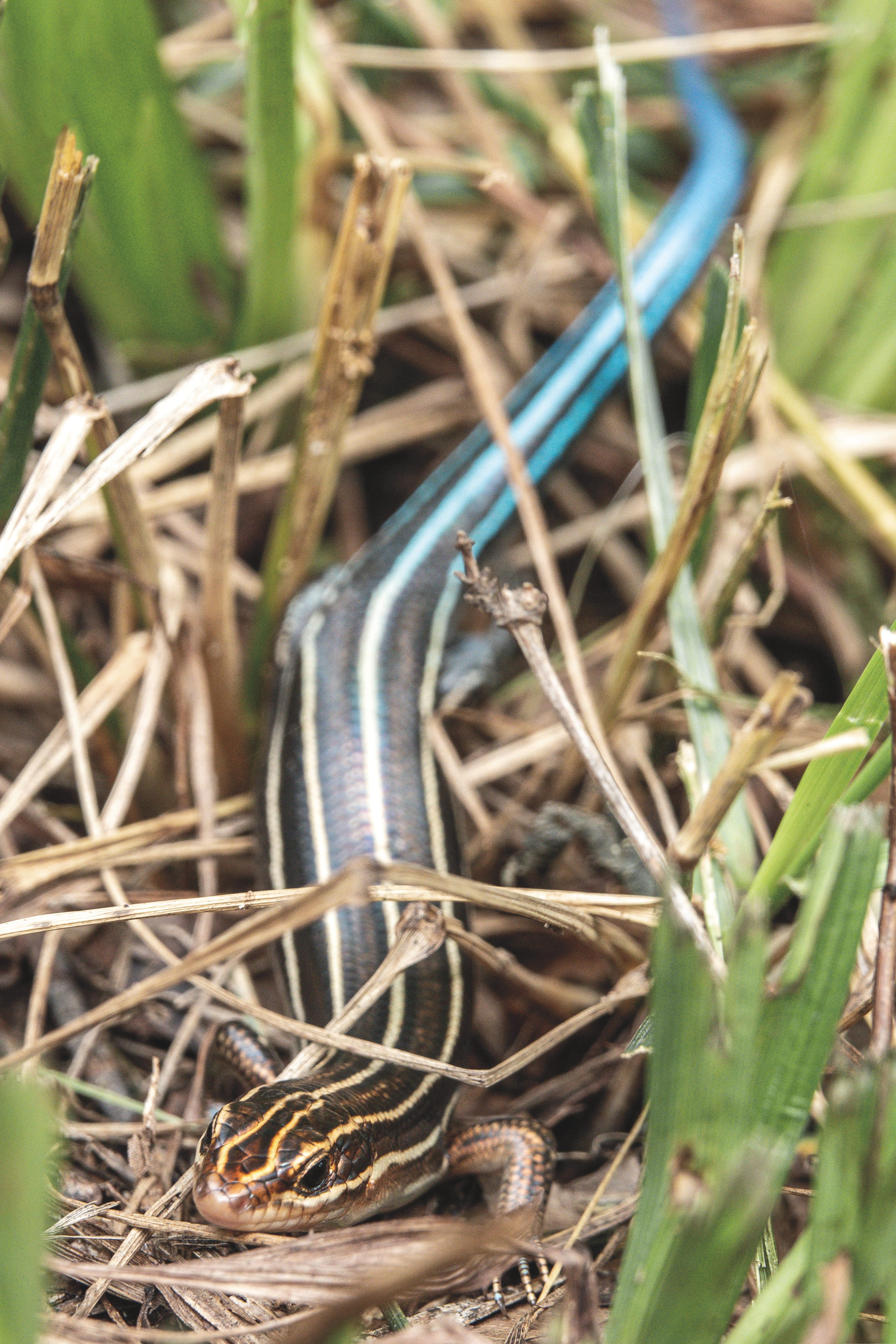
How did I find the skink? The color of the blue tail is out of place, but I think the stripe pattern was what caused a double-take. Or both of those combined. I only know that I detected something worth examining.
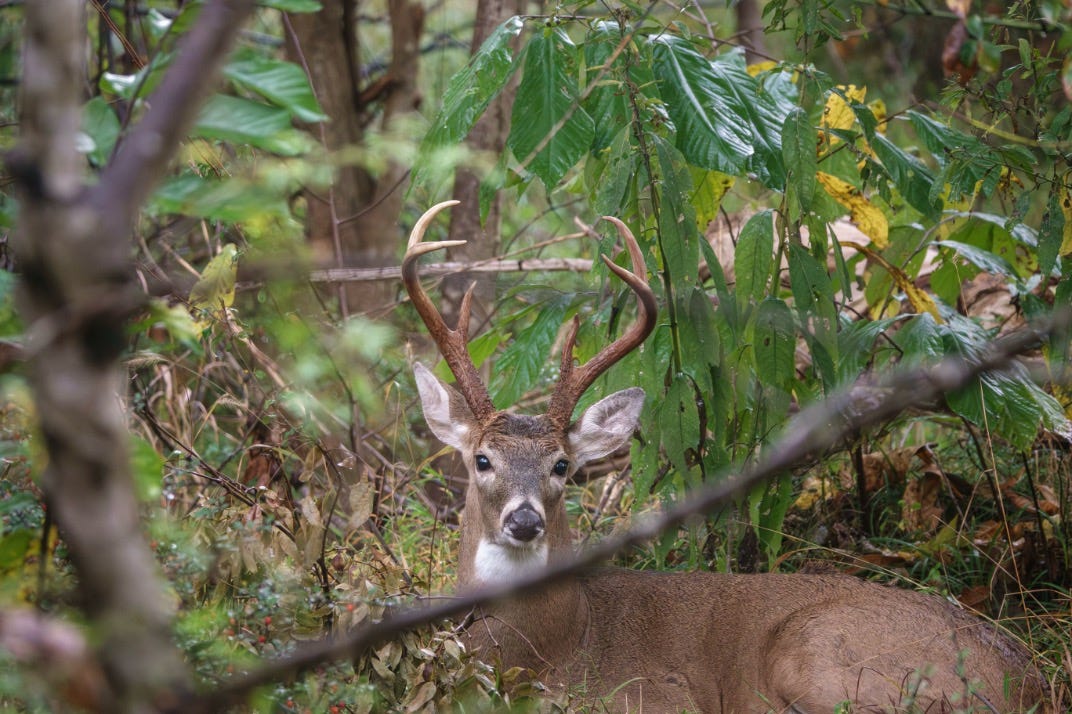
Here’s another example. I was walking back to the house from the parking lot. I had already put my camera back in the bag before I saw something and stopped.
How did I see this one? Pattern recognition. The antlers are not quite shaped like the branches around them, and the white patch on his chest is larger and different than other nearby bright spots. The ears too, especially when facing forward. From the resulting image you might think that I was standing 10 feet away and just stumbled upon him, but now you know it was seen from afar. Even with my “mediocre vision”.
You can do this too. It does take practice, and knowing your environment. In the jungle of Costa Rica I felt like I couldn’t find anything. The patterns were all new and unfamiliar, and sometimes I struggled even when somebody told me where to look. When I first got to Virginia all those falling leaves caused me to double take for days, until my brain eventually recognized the movement pattern and “told me” to ignore the leaves. Once I could ignore the leaves I could see other things that were there all along. And as you know by now, there were lots of things to see!
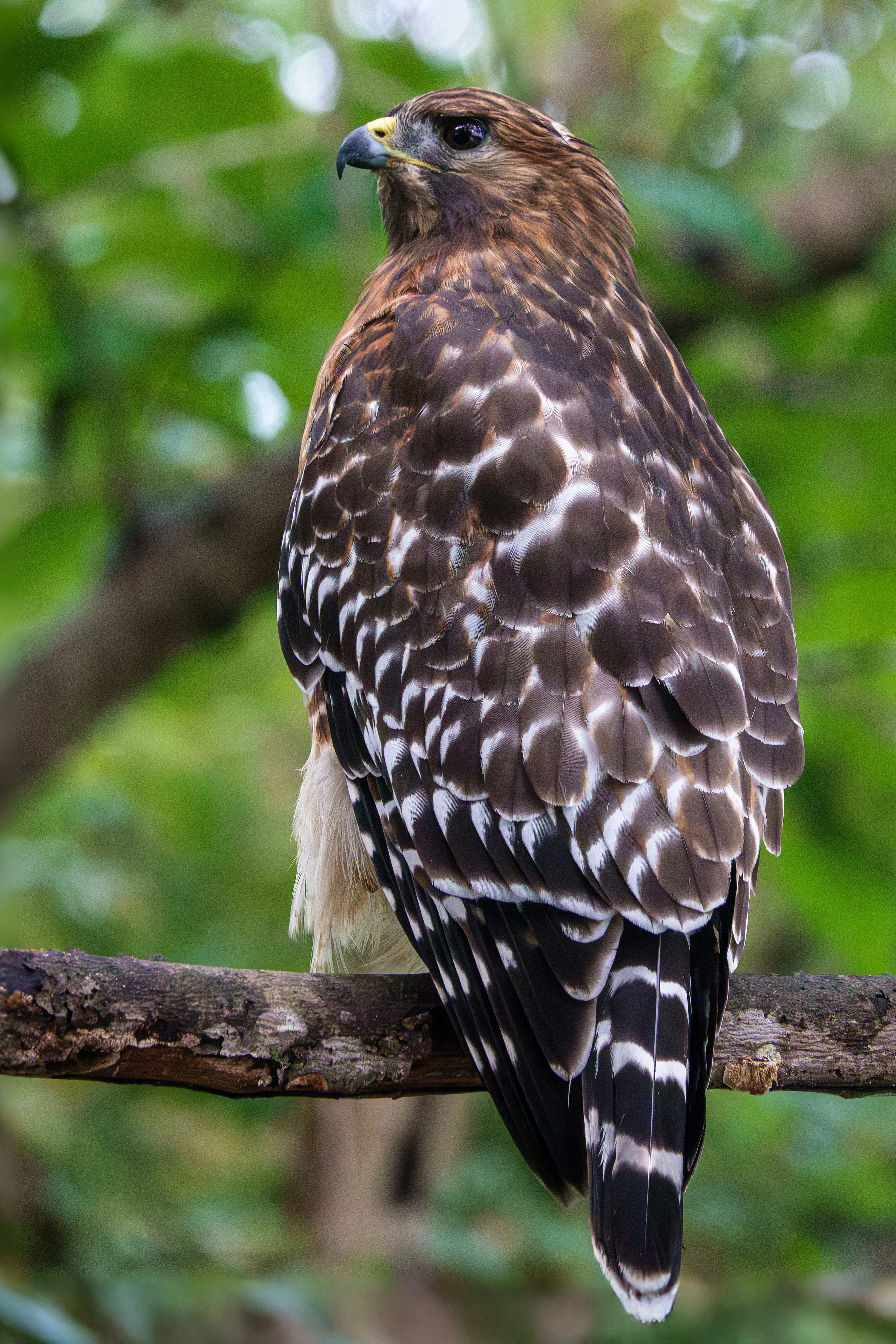
There are techniques you can employ, too. It helps to scan the whole environment regularly, depending on whether you hope to see a particular thing. If you’re looking for turtles, they aren’t in the trees. But scan anyway, if you want to be happily surprised. Because while hawks and eagles are usually up in higher branches, you never know unless you stay aware. I almost walked right into this Red-shouldered Hawk one day!
I’ll talk more about how to see things, not just wildlife, in the next post.
Why? Because whether you want to make photographs or not, your life can be a little bit richer when you learn to see more!
Until next time,

For more, see my new book, WILD GOOSE, A Suburban Wonder. Click the black button, top center.
Is there something here you like or dislike? Questions? Have anything else to say? Let us all know by clicking on the Comments button below, and express yourself. Don’t be shy, now.
If you like this post you’re bound to like the next one as well. I’m sending them weekly. Quit any time, or better yet, stay and read on!
Know anybody who should hear about all this? Be a friend and let them know!
Or, are you interested in seeing more work? My website welcomes you. We may even want to work together. I promise a joyous and productive experience if we do.
Visit: www.dobkinphoto.com
Here’s something fun. They put a GoPro (or equivalent) on the head of an eagle and you can get a sense of their distance vision. Flying over Dubai.
I’m not a cat, but I compare reasonably well to a golden retriever. Can’t get enough time with a ball, and always ready to eat.
If you’re a golfer, over time you learn to assess the distance to the flag. That’s an example of how capable we can be with depth perception. Think about that for a moment - it’s just a stick out in the distance, and with practice you might be able to tell that it’s between 180 and 200 yards away. 600 feet, and you know. That’s an impressive ability.
Love that Hawk photograph Donn!
I loved this post. I just got back from a cruise through the Alaskan Inland Passage. While my husband and I aren't cruise people (this was our first and probably last), we wanted to see the area. On a cloudy morning, shortly after leaving Vancouver, my eyes were peeled for movement. In the distance, I could see two separate pods of whale. Well, not the whales, but the blows. I've seen whales before, but it's still a thrill.